Elevating Digital Commerce with Isometric 3D Shopping Set Icons
In the rapidly evolving landscape of digital commerce, the visual language we use to communicate with users has shifted dramatically. Flat design ruled the roost for nearly a decade, prioritizing minimalism and speed. However, as screens become sharper and user expectations for immersive experiences grow, there is a distinct resurgence of depth, texture, and dimensionality. This is where Shopping Set Icons rendered in an Isometric 3d Style are making a profound impact. These aren't just decorative elements; they are functional assets that bridge the gap between abstract interface commands and tangible real-world objects.
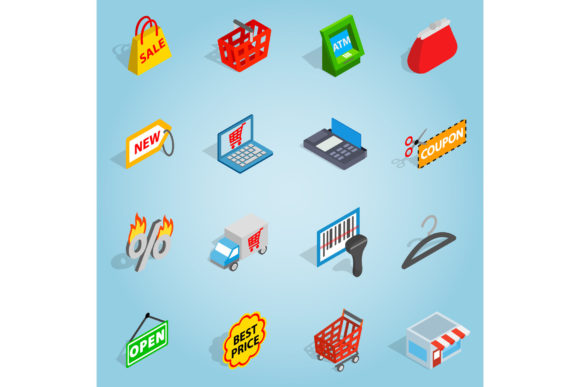
When designers and developers talk about an isometric shopping set icons collection, they are referring to a universal toolkit designed to streamline the creation of web and mobile UI. These vector illustrations cover the entire spectrum of the e-commerce journey, from the initial search to the final checkout. The beauty of this style lies in its ability to convey complex actions instantly. A flat icon of a cart is recognizable, but an isometric cart filled with colorful boxes tells a story of abundance and readiness. It adds a layer of psychological engagement that flat graphics often struggle to achieve.
The Strategic Advantage of Depth in User Interface
Why are modern interfaces leaning so heavily into three-dimensional aesthetics? The answer lies in usability and hierarchy. In a crowded mobile screen, distinguishing interactive elements from static content is crucial. Isometric 3d Style graphics naturally pop off the screen due to their simulated lighting and perspective. This creates an intuitive affordance; users instinctively know these elements are clickable or interactive because they resemble physical objects.
Consider the standard workflow of an online shopper. They need to visualize their basket, understand shipping options, and feel secure during payment. A comprehensive shopping set provides icons for each of these stages. When these icons share a consistent light source, angle, and color palette, they create a cohesive visual narrative. This consistency reduces cognitive load. The user doesn't have to re-learn what a "delivery truck" looks like on every page; the uniform style reinforces brand identity and navigational clarity.
Furthermore, the versatility of these assets cannot be overstated. Whether you are building a high-end fashion marketplace or a grocery delivery app, the fundamental elements remain the same. You need bags, boxes, credit cards, location pins, and user profiles. An isometric shopping set icons package serves as a universal foundation. It allows teams to launch MVPs (Minimum Viable Products) faster because the heavy lifting of asset creation is already done. Instead of spending weeks commissioning custom illustrations, developers can integrate pre-made, high-quality vectors immediately.
Technical Flexibility Across File Formats
One of the most critical factors professionals consider before adopting a new design resource is file compatibility. A beautiful icon set is useless if it doesn't fit into your existing pipeline. This is why top-tier collections offer a wide array of formats, including JPG, EPS, AI, PSD, and PNG. Each format serves a specific purpose in the modern design workflow.
- AI and EPS: These are the gold standards for vector graphics. Designers working in Adobe Illustrator rely on these formats to scale icons to any size without losing resolution. Need a massive banner for a desktop homepage or a tiny favicon for a mobile tab? Vector files ensure crisp edges every time. They also allow for easy color customization to match specific brand guidelines.
- PSD: For teams working in Photoshop, layered PSD files are invaluable. They allow designers to tweak shadows, adjust highlights, or swap out specific elements within the 3D composition without starting from scratch. This level of control is essential for creating unique marketing materials that still adhere to the core icon style.
- PNG: The workhorse of web development. PNGs with transparent backgrounds are ready to drop straight into code. They are optimized for performance and render perfectly across all browsers and operating systems.
- JPG: While less common for individual icons due to background limitations, JPGs are excellent for previewing the full set or using in non-transparent contexts like social media posts or email newsletters where file size is a primary concern.
Having access to all these formats means that the Shopping Set Icons are future-proof. As design tools evolve, having the source files ensures that your assets never become obsolete. It empowers both designers and developers to collaborate more effectively, reducing the back-and-forth typically associated with asset handoffs.
Integrating Isometric Assets into Modern Workflows
The adoption of Isometric 3d Style goes beyond mere aesthetics; it influences how teams approach product design. In agile environments, speed is currency. Using a pre-built isometric shopping set icons library accelerates the prototyping phase. Product managers can visualize flows in tools like Figma or Sketch using high-fidelity assets rather than wireframe placeholders. This leads to better stakeholder buy-in earlier in the process because the vision looks polished and realistic from day one.
Moreover, these icons play a pivotal role in onboarding sequences and empty states. An empty shopping cart can be a moment of friction for a user. However, replacing a blank screen with a charming, isometric illustration of an open box waiting to be filled transforms a negative experience into an inviting one. It encourages exploration and adds a touch of personality to the application. This emotional connection is often the differentiator between a user bouncing and a user converting.
For mobile UI specifically, the constraints of screen real estate make clarity paramount. Isometric icons, despite their 3D nature, can be designed to occupy compact spaces efficiently. The angled perspective often allows for more detail to be visible within a small footprint compared to a flat frontal view. This makes them ideal for navigation bars, feature grids, and promotional banners within apps.
Choosing the Right Set for Your Project
Not all icon sets are created equal. When selecting a shopping set for your next project, there are several qualities to evaluate. First, look for consistency in the Isometric 3d Style. Do all the icons share the same 30-degree angle? Is the lighting direction uniform? Inconsistencies here can make an interface feel disjointed and amateurish.
Secondly, assess the comprehensiveness of the set. A basic pack might only include a cart and a bag. A robust isometric shopping set icons collection should cover the entire ecosystem: search magnifying glasses, filter sliders, wishlist hearts, user avatars, secure lock symbols, and various payment method representations. The more complete the set, the less time you spend hunting for mismatched supplementary icons.
Finally, consider the adaptability of the colors. While many sets come with vibrant, predefined palettes, the best ones are easy to recolor. Brands have strict color codes, and the ability to shift the hue of a delivery truck or a shopping bag via the AI or EPS files is a non-negotiable feature for professional use.
In conclusion, the shift towards dimensional design is not a fleeting trend but a response to the need for richer, more engaging digital interactions. Shopping Set Icons crafted in an Isometric 3d Style offer a perfect blend of form and function. They provide the visual depth necessary to guide users intuitively while offering the technical flexibility required by modern development teams. By leveraging universal shopping elements available in versatile formats like JPG, EPS, AI, PSD, and PNG, creators can build interfaces that are not only beautiful but also highly effective at driving commerce. Whether you are refining an existing platform or launching a new venture, investing in high-quality isometric assets is a strategic move that pays dividends in user satisfaction and conversion rates.