Streamlining Digital Design with a Universal Infrastructure Set Icons
In the rapidly evolving landscape of web and mobile user interface design, clarity is currency. Whether you are building a smart city dashboard, a logistics management platform, or a utility service app, the ability to communicate complex structural concepts instantly is paramount. This is where a comprehensive Infrastructure Set Icons becomes an indispensable asset for designers and developers. These visual tools do more than just decorate a screen; they serve as the universal language that bridges the gap between raw data and user understanding. By utilizing a curated collection of isometric infrastructure icons, professionals can transform abstract technical information into intuitive, accessible experiences that drive engagement and efficiency.
Understanding the Role of Visual Assets in Complex Systems
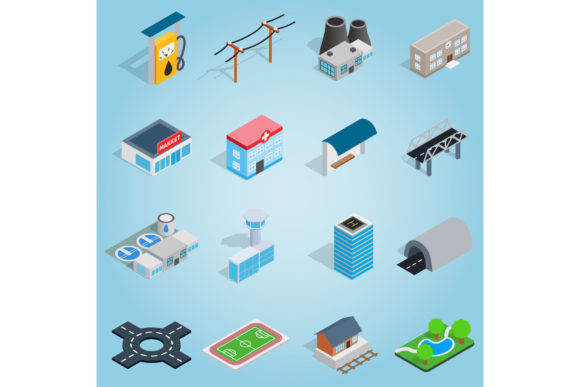
At its core, an Infrastructure Set Icons collection is a library of vector illustrations representing the fundamental elements of our built and digital environments. This includes everything from transportation networks like bridges, tunnels, and railways to energy grids, water treatment facilities, and communication towers. When these are rendered in an isometric style, they gain a unique three-dimensional quality that provides depth and context without the clutter of full photorealism. Isometric infrastructure icons set themselves apart by offering a clean, modern aesthetic that fits seamlessly into both light and dark mode interfaces, making them versatile for a wide array of applications.
The primary challenge facing UI designers today is information overload. Users are often presented with dense dashboards filled with metrics, maps, and status indicators. Without clear visual cues, critical information can get lost, leading to confusion or decision paralysis. The goal for any design team is to reduce cognitive load while maintaining high information density. A well-structured set of basic infrastructure elements vector illustration allows designers to categorize and label complex systems instantly. Instead of reading a text label that says "Substation," a user sees a recognizable icon, processing the meaning in a fraction of a second.
Addressing Design Challenges with Versatile Formats
One of the most significant hurdles in professional design workflows is compatibility and scalability. Designers often struggle with assets that pixelate when resized or require specific software that not all team members possess. A high-quality Infrastructure Set Icons package solves this by providing files in multiple industry-standard formats, including JPG, EPS, AI, PSD, and PNG. This variety ensures that no matter where you are in the design pipeline, you have the right tool for the job.
For instance, when working on the initial conceptual phase in Adobe Illustrator, the AI and EPS vector files allow for infinite scalability. You can stretch an icon to fit a billboard or shrink it for a mobile notification bar without losing a single pixel of sharpness. This is crucial for responsive design, where elements must adapt to various screen sizes dynamically. Conversely, when handing off designs to developers or integrating them directly into code, the PNG format offers transparency and immediate usability. For those needing to customize colors or add shadows within Photoshop, the layered PSD files provide the necessary flexibility. Even for quick previews or documentation, the JPG format serves as a lightweight option. Having access to all these formats within a single infrastructure icons set eliminates the friction of file conversion and ensures consistency across the entire project lifecycle.
Practical Applications Across Industries
The utility of a universal infrastructure icons set extends far beyond simple decoration. In the realm of Smart City planning applications, these icons help visualize traffic flow, energy consumption, and waste management systems. Planners and citizens alike can interact with maps populated by isometric infrastructure icons that clearly distinguish between a solar farm and a wind turbine, or a subway station and a bus terminal. This visual distinction is vital for accurate data interpretation.
In the logistics and supply chain sector, tracking goods requires a clear representation of the journey. An app displaying the status of a shipment might use icons to represent ports, warehouses, highways, and airports. By using a cohesive set of basic infrastructure elements vector illustration, the interface maintains a professional look while guiding the user through the logistical chain. Similarly, in utility management software, technicians in the field can use mobile apps featuring these icons to identify specific grid components, report outages, or schedule maintenance. The isometric perspective adds a layer of realism that helps users mentally map the digital icon to the physical asset they are standing in front of.
Furthermore, educational platforms and news outlets covering urban development or engineering projects benefit immensely from these resources. Explaining how a hydroelectric dam works or the layout of a new railway system becomes significantly easier when accompanied by clear, stylized graphics. The Infrastructure Set Icons act as visual anchors that keep the audience engaged and informed.
Tailoring the Approach for Different Users
Different professionals will approach the implementation of an Infrastructure Set Icons library based on their specific needs and workflows. A UI/UX Designer might focus heavily on the aesthetic consistency and the ability to recolor vectors to match a brand's palette. They will likely spend time in the AI or PSD files, tweaking strokes and gradients to ensure the isometric infrastructure icons set blends perfectly with the rest of the design system. Their priority is the user experience and the visual harmony of the final product.
On the other hand, a Front-End Developer will prioritize the PNG and SVG (often derived from EPS/AI) formats for performance and ease of integration. They need assets that load quickly and render correctly across different browsers and devices. For them, the value lies in the ready-to-use nature of the files, reducing the time spent on asset optimization. Meanwhile, a Project Manager or Presenter might utilize the JPG or pre-rendered PNG versions for slide decks and reports, needing immediate visual impact without the need for editing software.
Startups with limited resources may find a universal set particularly valuable because it removes the need to hire an illustrator for every new feature. Instead of commissioning custom art for a new "5G Tower" feature, they can pull a matching icon from the existing library, ensuring speed to market and visual consistency. Large enterprises, conversely, may use these sets as a baseline, customizing the EPS or AI files to create a proprietary sub-set that aligns strictly with their corporate identity guidelines.
Maximizing Value Through Strategic Implementation
To get the most out of your Infrastructure Set Icons, consider the context in which they will be viewed. Isometric icons work best when there is enough whitespace around them to let their 3D structure breathe. Crowding them can diminish their effectiveness. When designing for mobile UI, ensure that the level of detail in the vector illustration remains legible at smaller sizes; sometimes, simplifying the stroke weight or removing minor details is necessary for tiny touch targets.
Consistency is key. Once you select an isometric infrastructure icons set, stick with it throughout the project. Mixing different styles—such as flat icons with isometric ones—can create a disjointed user experience that feels unprofessional. Use the color palette provided in the PSD or AI files as a starting point, but feel free to adapt it to your semantic needs. For example, using red tones for critical infrastructure alerts and green for operational status can enhance the functional value of the icons.
Ultimately, the goal is to make the complex simple. A well-chosen Infrastructure Set Icons collection empowers you to build interfaces that are not only beautiful but also deeply functional. By addressing the real-world needs of users through clear, scalable, and versatile visual elements, you elevate the quality of your digital products. Whether you are mapping out the future of urban living or optimizing a delivery route, these basic infrastructure elements vector illustrations are the building blocks of effective communication in the digital age.