Evaluating Isometric 3D Hacking Icons for Modern UI Design
In the rapidly evolving landscape of digital interface design, the choice of iconography plays a pivotal role in establishing tone, clarity, and user engagement. Among the various stylistic approaches available, the Hacking Set Icons, Isometric 3d Style has emerged as a distinct and popular resource for designers working on cybersecurity dashboards, tech-focused mobile applications, and educational platforms. This specific collection offers a universal set of basic hacking elements rendered in a vector illustration format that mimics three-dimensional depth without requiring complex 3D modeling software. Understanding the nuances of this style, its available formats—including JPG, EPS, AI, PSD, and PNG—and its practical application compared to flat or linear alternatives is essential for making an informed design decision.
Defining the Isometric 3D Aesthetic in Cybersecurity Contexts
The term "isometric" refers to a method of visual representation where three-dimensional objects are drawn in two dimensions, with all three coordinate axes appearing equally foreshortened and the angles between any two of them being 120 degrees. When applied to a Hacking Set Icons, Isometric 3d Style, this approach transforms abstract concepts like encryption, firewalls, data breaches, and network nodes into tangible, block-like structures. Unlike traditional flat icons, which rely solely on color and silhouette, isometric icons utilize light, shadow, and perspective to create a sense of volume and hierarchy.
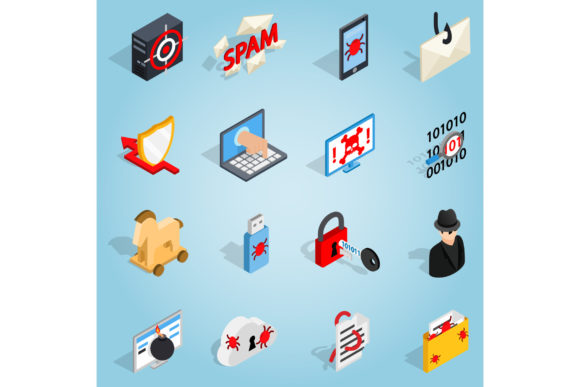
What makes this particular set distinct is its focus on "hacking" elements. The imagery typically includes stylized representations of servers, padlocks, binary code streams, hooded figures, drones, and satellite dishes, all constructed with consistent geometric rules. This consistency is crucial for UI design, as it ensures that a "database" icon looks like it belongs in the same ecosystem as a "malware detection" icon. The 3D effect adds a layer of sophistication and modernity, often associated with high-tech industries, making it particularly effective for products that need to convey advanced technological capabilities.
Format Versatility: Navigating JPG, EPS, AI, PSD, and PNG
One of the primary factors in evaluating any design asset is its file format flexibility. A comprehensive Isometric 3d hacking set icons package typically provides a wide array of formats to suit different stages of the design workflow. Understanding the specific utility of each format—JPG, EPS, AI, PSD, and PNG—is vital for integrating these assets efficiently.
- AI (Adobe Illustrator) and EPS: These are vector formats. They are arguably the most critical for professional UI work because they allow for infinite scalability. Whether you are designing a small favicon or a massive billboard, vector files ensure the edges remain crisp. They also permit full editing of shapes, colors, and strokes, allowing designers to customize the hacking elements to match a specific brand palette.
- PSD (Photoshop): This format preserves layers. For an isometric set, this is invaluable because the 3D effect is often achieved through multiple layers of shading and highlighting. A PSD file allows a designer to toggle shadows, change the angle of light, or isolate specific components of a hacking tool icon without starting from scratch.
- PNG: Portable Network Graphics offer lossless compression with transparency support. This is the go-to format for immediate implementation in web and mobile interfaces where vector rendering might be overkill or unsupported. High-resolution PNGs from an isometric set provide ready-to-use assets that maintain quality on retina displays.
- JPG: While less common for individual UI icons due to the lack of transparency, JPGs are useful for previewing the entire set or using the icons within blog posts and marketing materials where file size is a stricter constraint and background transparency is not required.
Comparative Analysis: Isometric 3D vs. Flat and Linear Styles
When choosing between a Hacking Set Icons, Isometric 3d Style and other prevalent styles, designers must weigh aesthetic appeal against functional performance. The two main alternatives are flat design (Material Design, iOS flat) and linear (outline) icons.
Visual Depth vs. Clarity: Isometric icons excel in creating visual interest and breaking the monotony of flat interfaces. They are excellent for hero sections, onboarding screens, and feature highlights where the goal is to capture attention. However, at very small sizes (e.g., 16x16 pixels in a dense navigation bar), the intricate details of isometric shading can become muddy. In contrast, flat or linear icons maintain superior legibility at small scales. If your application requires a dense dashboard with hundreds of data points, a simpler style might be more appropriate for the core navigation, reserving the isometric set for illustrative purposes.
Customization Effort: Modifying a flat icon is generally straightforward; changing a fill color is a single action. With an Isometric 3d hacking set, changing the color scheme often requires adjusting gradients and shadows to maintain the illusion of light source consistency. This adds a layer of complexity to the design process. Designers who need to rapidly prototype multiple themes may find the vector editing requirements of isometric assets more time-consuming than their flat counterparts.
Performance Considerations: While vector formats (AI, EPS, SVG) are efficient, complex isometric illustrations can contain many anchor points and gradient meshes. When exported to SVG for the web, these files can be larger in kilobyte size compared to simple line icons. For mobile applications where load time and data usage are critical, this trade-off must be evaluated. Using PNGs optimized for web can mitigate this, but it sacrifices the scalability benefit of vectors.
Ideal Use Cases and Strategic Implementation
Determining when to deploy a Universal hacking icons set in an isometric style depends heavily on the project's goals. These assets are particularly well-suited for:
- Cybersecurity Marketing Landing Pages: The dramatic nature of 3D hacking imagery helps visualize invisible threats and solutions, making abstract security concepts concrete for potential clients.
- EdTech and Training Modules: For courses teaching ethical hacking or network administration, isometric icons can serve as engaging visual aids that differentiate modules (e.g., "Network Scanning" vs. "Penetration Testing") more distinctly than generic flat icons.
- SaaS Dashboards: In B2B software, using isometric illustrations for empty states (e.g., "No threats detected") or welcome screens adds a premium feel that can enhance perceived product value.
Conversely, there are scenarios where this style may not be the optimal choice. Highly utilitarian internal tools, developer documentation, or minimalist apps prioritizing speed and simplicity often benefit more from understated, monochromatic icon sets. In these environments, the decorative nature of isometric art can be perceived as distracting or unnecessary clutter.
Limitations and Decision Factors
Before committing to a Hacking Set Icons, Isometric 3d Style for a long-term project, several limitations should be considered. First is the issue of trend longevity. While isometric design has remained popular for several years, it is more susceptible to dating than classic flat or outline styles. Designers aiming for a timeless look might prefer a more neutral approach.
Secondly, consistency across a large library can be challenging. A pre-made set usually contains a fixed number of icons (often between 20 to 50). If your project grows and requires niche hacking concepts not included in the original vector illustration pack, creating new icons that perfectly match the existing lighting, angle, and detail level requires significant skill. Extending a custom isometric set is far harder than drawing a new line icon to match an existing set.
Finally, accessibility is a key consideration. Complex 3D icons can sometimes be difficult for users with visual impairments to interpret quickly. Ensuring that these icons are paired with clear text labels and proper ARIA tags in web implementations is non-negotiable. The artistic flair of the isometric style should never come at the cost of usability.
Making the Final Choice
Selecting the right iconography is a balance between aesthetic ambition and functional pragmatism. The Hacking Set Icons, Isometric 3d Style offers a powerful visual language for projects that need to communicate innovation, depth, and technical prowess. Its availability in versatile formats like AI, PSD, and PNG ensures that it can fit into various workflows, from initial concepting to final deployment.
However, it is not a one-size-fits-all solution. Designers must critically assess their specific context: Do they need the visual pop of 3D, or the clarity of flat design? Do they have the resources to maintain and extend a complex vector library? By weighing these factors against the project's requirements, teams can decide whether this dynamic style will elevate their user interface or if a simpler alternative would better serve their users' needs. Ultimately, the best choice is the one that enhances communication without compromising the efficiency of the digital experience.