Isometric 3D Education Icons for Modern UI
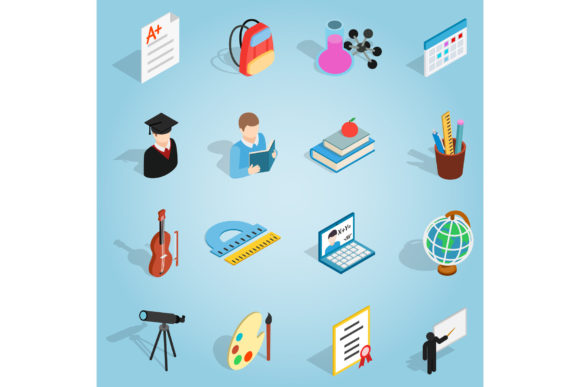
In the rapidly evolving landscape of digital design, the visual language we use to communicate complex ideas matters more than ever. Education Set Icons, Isometric 3d Style represents a significant shift away from flat, two-dimensional symbolism toward depth, perspective, and tactile realism. These are not merely decorative elements; they are functional tools designed to bridge the gap between abstract educational concepts and user understanding. When you integrate an isometric education set icons collection into your workflow, you are choosing a style that offers clarity through dimension, making interfaces feel more inviting and interactive.
The appeal of the isometric aesthetic lies in its unique ability to present objects without the distortion of traditional perspective. Every element maintains its scale, allowing designers to arrange school desks, graduation caps, books, and digital tablets in cohesive scenes that tell a story. This universal education icons approach ensures that whether you are building a mobile app for kindergarten learners or a corporate training dashboard for professionals, the visual tone remains consistent and professional. The 3D aspect adds a layer of sophistication, catching the eye without overwhelming the content, which is crucial for maintaining user engagement in today's attention-scarce environment.
Why Depth Matters in Educational Interfaces
Flat design has served the web well for years, but there is a growing fatigue with overly minimalistic interfaces that can sometimes feel sterile or indistinguishable from one another. Introducing depth through Education Set Icons, Isometric 3d Style injects personality and warmth into user experiences. For educators and ed-tech entrepreneurs, this means creating an emotional connection with the learner before they even click a button. A three-dimensional icon of an open book feels more tangible and inviting than a simple outline, subconsciously encouraging interaction.
From a practical standpoint, these icons serve as excellent navigational aids. In complex learning management systems (LMS) or mobile study apps, users need to quickly distinguish between different modules—such as "Assignments," "Grades," "Library," and "Community." The distinct angles and shading inherent in the isometric style make each icon instantly recognizable. This reduces cognitive load, allowing students and professionals to focus on the learning material rather than deciphering the interface. Furthermore, the versatility of formats like JPG, EPS, AI, PSD, PNG ensures that these assets can be scaled from tiny mobile thumbnails to large desktop banners without losing crispness or detail.
Creative Applications Across Industries
The utility of a high-quality set of basic education elements vector illustration extends far beyond traditional schooling. Creators and marketers can leverage these assets to build compelling narratives for diverse audiences. Consider the following applications where this style shines:
- E-Learning Platforms: Use detailed 3D icons to represent course categories. A chemistry set, a globe, or a coding laptop rendered in isometric view can instantly convey the subject matter, making course catalogs visually scannable.
- Corporate Training: Human resources departments can utilize these icons to gamify employee onboarding. Progress bars accompanied by 3D trophies or certificates create a sense of achievement and motivate staff to complete modules.
- Ed-Tech Startups: For pitch decks and landing pages, isometric illustrations suggest innovation and modernity. They help startups stand out in a crowded market by presenting their solutions as cutting-edge and user-friendly.
- Blogging and Content Marketing: Writers and publishers can break up long-form text with relevant 3D visuals. An article about remote learning becomes more engaging when paired with an isometric scene of a home office setup with educational tools.
- Mobile App UI: Given the screen real estate constraints on mobile devices, clear iconography is vital. Isometric icons provide enough detail to be distinctive even at small sizes, enhancing the overall usability of education-focused apps.
Adapting Styles for Different Audiences
One of the greatest strengths of using a universal education icons pack is its adaptability. While the core style remains isometric, the application can be tweaked to suit specific demographics. For younger audiences, such as children in primary education, designers might opt for brighter color palettes, softer shadows, and more playful arrangements of the 3D elements. The goal here is to spark curiosity and make learning feel like play.
Conversely, when targeting adult learners, university students, or corporate professionals, the approach should be more restrained. Muted tones, sharper lines, and a focus on functionality over whimsy work best. In these contexts, the Education Set Icons, Isometric 3d Style serves to organize information efficiently rather than entertain. The key is consistency; once you choose a color scheme and lighting direction, apply it across all assets to maintain a cohesive brand identity. This professionalism builds trust with your audience, signaling that the educational content provided is equally rigorous and well-structured.
Technical Flexibility and Workflow Integration
For designers and developers, the technical specifications of asset libraries are just as important as their visual appeal. Having access to files in AI, EPS, PSD, PNG, and JPG formats provides unparalleled flexibility. Vector formats like AI and EPS are essential for scalability. You can resize a graduation cap icon from a favicon to a billboard graphic without any pixelation, ensuring your brand looks sharp on every device. This is particularly important for responsive web design, where elements must adapt fluidly to various screen sizes.
On the other hand, raster formats like PNG and PSD offer ready-to-use layers with transparency, speeding up the prototyping phase. If you are a marketer with limited design resources, being able to drag and drop a high-quality PNG directly into a social media post or email newsletter saves valuable time. The PSD format allows for deeper customization, letting you adjust lighting, colors, or textures to match specific campaign themes without needing to redraw the entire icon from scratch. This efficiency enables teams to iterate faster and launch projects sooner.
Maintaining Clarity and Consistency
While the creative possibilities are endless, it is crucial to avoid clutter. The beauty of isometric design can become a distraction if overused. To keep results clear and effective, adhere to the principle of hierarchy. Use the most detailed 3D illustrations for hero sections or key call-to-action areas, and rely on simplified versions for secondary navigation or footnotes. Ensure that the lighting source remains consistent across all icons; conflicting shadows can make an interface look disjointed and unprofessional.
Additionally, consider accessibility. While 3D icons are visually striking, they must not compromise usability. Ensure there is sufficient contrast between the icon colors and the background. Pair icons with text labels whenever possible, especially for critical functions, to assist users who may rely on screen readers or have difficulty interpreting abstract symbols. By balancing aesthetic innovation with inclusive design practices, you ensure that your educational tools are accessible to everyone.
Fueling Inspiration for Future Projects
Ultimately, incorporating Education Set Icons, Isometric 3d Style into your toolkit is about more than just aesthetics; it is about enhancing communication. Whether you are an educator looking to refresh your course materials, a developer building the next great learning app, or a blogger seeking to illustrate complex ideas, these assets provide a solid foundation for creativity. They invite you to think in three dimensions, to arrange space thoughtfully, and to present information in a way that resonates with modern users.
As you explore the potential of these isometric education set icons, remember that the best designs are those that serve the user. Let the depth and detail of these illustrations guide your users through their learning journey, making every click feel intentional and every lesson memorable. With the right combination of creative vision and practical application, these universal education elements can transform ordinary interfaces into extraordinary experiences.